


The Role of AI Slides in Crafting a Compelling Digital Marketing Story
Last updated on April 20, 2026 by RGB Web Tech
Digital marketing, since its inception, has been a dynamic force, continually adapting and evolving with the rapid advancements in technology and shifts in consumer behavior. If we trace back to the late 1990s and early 2000s, we find ourselves in an era where businesses were just beginning to recognize the potential of the Internet as a marketing platform. Banner ads, rudimentary search engine optimization, and email marketing were the order of the day.
Fast forward to the present, and the landscape is drastically different. With the proliferation of social media, influencer marketing, video streaming, and mobile technology, businesses have access to an array of tools and platforms to reach their target audience. However, with this explosion of data and platforms, the challenge of sifting through massive amounts of information and crafting tailored, compelling messages has intensified.
Enter Artificial Intelligence (AI). The role of AI in today's marketing is akin to having a super-powered assistant that can analyze vast datasets at lightning speed, predict consumer behavior, automate repetitive tasks, and even create content.
AI’s capabilities aren't just limited to analytics or automation. It's fundamentally reshaping the way brands interact with consumers, making experiences more personalized and efficient. From chatbots offering instant customer service to algorithms that curate personalized content recommendations, AI has seamlessly integrated itself into the very fabric of modern marketing.
Background: The Shift to Digital Storytelling
In the evolving landscape of marketing, a significant shift has occurred from traditional methods to digital strategies.
Traditional marketing, encompassing mediums like television, radio, and print, was primarily one-directional. Brands sent out their messages, hoping they'd resonate with their target demographic.
On the other hand, digital marketing operates in a more interactive realm—thanks to social media, email campaigns, SEO, and more, marketers can establish a two-way communication with their audience.
This brings us to the heart of the matter: storytelling. At the core of every memorable marketing campaign is a compelling story. While traditional marketing did employ storytelling, the digital age has magnified its importance manifold.
In the digital world, audiences have a plethora of options at their fingertips. To capture their attention, brands must craft narratives that are not only engaging but also relatable, helping to boost sales with stunning visuals.
Digital storytelling isn't just about promoting a product or service; it's about creating a connection, eliciting emotions, and fostering loyalty. With the power of digital tools, stories can be woven seamlessly across multiple platforms, ensuring a cohesive and immersive experience for the audience. Moreover, digital storytelling allows for instant feedback, letting brands tweak their narratives based on audience reactions in real-time.
What are AI Slides?
In the rapidly evolving digital landscape, the term "AI Slides" has been gaining traction. But what exactly are they? At its core, AI Slides refer to presentation slides that are either created, enhanced, or managed with the help of artificial intelligence. Unlike the traditional method of manually designing each element, these slides harness the power of AI to optimize content, design, and delivery for the target audience.
The difference between AI Slides and traditional slide presentations is profound. For one, the manual labor required in conventional slides often means hours spent on design, content placement, and formatting. While human creativity is irreplaceable, it can sometimes be hampered by the tediousness of slide creation.
AI Slides, streamline this process. By analyzing the content, they can suggest or even automatically implement design choices that maximize clarity and engagement. Furthermore, these AI-enhanced slides can adapt in real-time. Imagine presenting to an audience and having your slides adjust based on their reactions or feedback, ensuring optimal engagement throughout.
In essence, while traditional slide presentations rely heavily on the presenter's skill in both design and delivery, AI Slides augment this process, making it more efficient and tailored. They represent a blend of human creativity with machine efficiency, promising a future where presentations are more engaging, adaptive, and effective than ever before.
The Unparalleled Benefits of Using AI Slides in Digital Marketing
In the ever-evolving landscape of digital marketing, the ability to tell a compelling story is paramount. AI Slides, an innovative tool that can seamlessly convert text to presentation, is playing a pivotal role in reshaping this narrative. Here are the standout benefits of incorporating AI Slides into your digital marketing strategy:
- Improved Audience Engagement: AI Slides intuitively understands the essence of your content. By converting raw text to visually appealing presentations, it captures the audience's attention more effectively than traditional slides, ensuring your message resonates. Also for improving engagement people are using AI dubbing platforms for increasing their content reach.
- Efficient Resource Allocation: Time, effort, and money – these are the pillars of any successful marketing campaign. AI Slides streamline the process, enabling marketers to transform extensive research or content into engaging slides within moments. This efficiency means resources can be redirected to other crucial aspects of the campaign.
- Higher Conversion Rates and ROI: An engaged audience is more likely to convert. By tailoring presentations to audience preferences and insights, AI Slides enhance the probability of turning a viewer into a customer, thereby boosting ROI.
- Seamless Integration with AI-powered Tools: AI Slides don't operate in isolation. They can be effortlessly integrated with other AI-driven marketing tools, ensuring a holistic and enhanced user experience.
Crafting a Narrative with AI
In the modern era of digital marketing, crafting a captivating narrative has never been more essential. And with the advent of Artificial Intelligence (AI), this process has become more dynamic and tailored than ever before.
Every audience is unique. They have different preferences, pain points, and aspirations. Traditionally, understanding these nuances required extensive market research, often consuming significant time and resources.
Enter AI. With its unparalleled data processing capabilities, AI sifts through vast amounts of data, offering insights about the target audience's behavior, preferences, and more. By leveraging these insights, marketers can craft content that resonates deeply with their intended audience. Whether it's a millennial tech enthusiast or a baby boomer health aficionado, AI helps in pinpointing precisely what appeals to them, ensuring every word and image hits the mark.
Predicting how an audience will react to a marketing message has always been a mix of art and science. However, AI is tipping the scales towards science. Sophisticated algorithms can now predict audience reactions based on historical data, current trends, and more.
If a piece of content is likely to evoke a less-than-desirable reaction, marketers can tweak it in real-time. It's akin to having a crystal ball that offers glimpses into potential future outcomes, allowing for timely adjustments. In an age where the digital landscape is incredibly fluid, this ability to adapt on-the-fly is invaluable.
Conclusion
Digital marketing has undergone transformative changes with the advent of advanced technologies, especially artificial intelligence. At the forefront of this revolution are AI Slides, which have proven to be indispensable tools for marketers. Their ability to craft compelling narratives tailored to specific audiences is unparalleled. By analyzing vast datasets, these AI-driven slides bring forward stories that resonate, ensuring that brands can communicate their messages more effectively and engagingly than ever before.
Looking ahead, AI's influence in digital marketing is poised for even greater expansion. It's not just about slides or presentations; the entire digital marketing ecosystem is becoming more intertwined with AI. From chatbots that provide personalized shopping experiences to predictive analytics shaping content strategies, AI's footprint is omnipresent.
As algorithms become more sophisticated, we can anticipate a future where marketing campaigns are predominantly AI-driven, ensuring maximum reach and impact. This isn't just a possibility; it's an imminent reality. Marketers, thus, must embrace and adapt to this AI-centric world, ensuring they harness its full potential while maintaining the authentic human touch that connects us all
If you found this article helpful, we encourage you to share it on your social media platforms—because sharing is caring! For more information about article submissions on our website, feel free to reach out to us via email.
Send an email
Written by RGB Web Tech
Latest Technology Trends
Latest technology trends shaping the future, including AI advancements, blockchain innovation, 5G connectivity, IoT integration, and sustainable tech solutions. Explore breakthroughs in quantum computing, cybersecurity, augmented reality, and edge computing. Stay ahead with insights into transformative technologies driving innovation across industries and revolutionizing how we live, work, and connect.
How AI Is Redefining the Future of News & Information Work
Last updated on April 20, 2026 by RGB Web Tech

The newsroom I visited last year looked nothing like the ones I remembered from a decade ago.
Fewer people sat at desks. The ones who remained focused on tasks that seemed fundamentally different from traditional journalism. They curated, verified and refined rather than starting from blank pages. The raw material for their work arrived already structured, summarised and sometimes nearly complete.
What I witnessed was not the death of journalism but its transformation. Artificial intelligence had become embedded in workflows that once depended entirely on human effort. The humans remained essential but their roles had evolved in ways that raise profound questions about the future of knowledge work.
This shift extends far beyond newsrooms. Every industry that creates, processes or distributes information is navigating similar changes. Understanding what is happening and what it means requires looking past both utopian promises and dystopian fears toward the more complex reality emerging in practice.
The Automation of Information Assembly
News creation has always involved assembly as much as creation.
Journalists gather facts from sources. They synthesise information from documents and databases. They structure narratives according to established conventions. Much of this work is systematic enough that machines can now perform it with surprising competence.
Artificial intelligence systems can monitor data sources continuously, identify newsworthy patterns and generate initial drafts faster than any human team. Financial earnings reports, sports scores, weather updates and routine government filings have become natural candidates for automated coverage.
The technology has matured significantly in recent years. Modern systems produce text that reads naturally, follows journalistic conventions and requires minimal human editing for straightforward applications. What once seemed like science fiction has become operational reality at major news organisations worldwide.
This does not mean machines have replaced journalists. Rather, it means the nature of journalistic work is shifting toward tasks that automation cannot yet perform. Investigation, relationship building, contextual judgment and ethical reasoning remain distinctly human contributions.
The Rise of Workflow Automation
The most significant developments are happening not in fully autonomous systems but in workflow augmentation.
Rather than replacing human workers entirely, AI increasingly handles specific steps within larger processes. A system might monitor sources and flag potentially newsworthy developments. Another might generate initial drafts that humans then refine. Yet another might optimise headlines or suggest relevant context.
This workflow approach reflects how AI actually delivers value in most knowledge work contexts. Complete autonomy remains elusive for complex tasks. Targeted assistance at specific process steps proves more practical and often more valuable.
The tools enabling this approach have multiplied rapidly. An AI news generator workflow can now be configured to handle specific content types with minimal technical expertise required. The barrier to implementing AI assistance has dropped dramatically, making these capabilities accessible to organisations that could never have developed them independently.
What interests me most is how this accessibility is changing competitive dynamics. The efficiency advantages that early adopters gained are becoming table stakes. Organisations that once led through AI implementation now find competitors catching up quickly as tools become commoditised.

Quality and Trust Considerations
Speed and efficiency gains mean little if they undermine quality and trust.
This concern is not hypothetical. AI systems can and do produce errors, fabrications and biased outputs. The consequences in news contexts are particularly severe. Misinformation spreads faster than corrections. Trust once lost proves difficult to rebuild.
The organisations handling AI-augmented news production responsibly have developed robust verification workflows. They treat AI outputs as drafts requiring human review rather than finished products ready for publication. They maintain human accountability for everything that reaches audiences.
This approach acknowledges that current AI systems lack genuine understanding of the world they describe. They predict plausible text without comprehending whether that text is true. The gap between plausible and accurate creates risks that responsible publishers must actively manage.
Training and editorial standards become more important rather than less important in AI-augmented environments. The humans reviewing machine outputs need sufficient expertise to catch errors that might be subtle and sophisticated. Reducing human oversight as AI capabilities grow would be precisely wrong.
Economic Pressures and Editorial Integrity
The news industry faces severe economic pressures that shape AI adoption decisions.
Advertising revenues have migrated to platforms. Subscription models work for some publishers but not all. Cost reduction feels existential rather than optional for many organisations. AI promises efficiency gains that struggling publishers cannot ignore.
This economic context creates genuine risks. Publishers desperate to reduce costs might implement AI without adequate quality controls. They might reduce human oversight below levels that maintain editorial standards. They might prioritise speed over accuracy in ways that damage both journalism and public discourse.
The technology itself is neutral on these questions. AI can enable higher quality journalism through better research, faster fact-checking and more comprehensive coverage. Or it can enable lower quality journalism through reduced human involvement and degraded standards. The outcomes depend on choices publishers make.
I worry that economic pressures will push too many organisations toward the wrong choices. The short-term savings from aggressive automation may not justify the long-term costs of diminished trust and damaged reputation. But organisations facing immediate survival threats often cannot prioritise long-term considerations appropriately.

Broader Implications for Knowledge Work
What is happening in news creation reflects broader patterns across knowledge work.
Legal research, financial analysis, medical documentation, marketing content and countless other information-intensive activities are experiencing similar transformations. AI systems increasingly handle routine cognitive tasks that once required trained professionals.
The implications extend beyond employment effects, though those matter significantly. The nature of expertise itself is shifting. Knowing how to do something matters less when machines can do it. Knowing what to do and why becomes relatively more important.
This shift favours different skills than traditional education and training developed. Critical evaluation of machine outputs. Judgment about when automation is appropriate. Understanding of the limitations and failure modes of AI systems. These capabilities were once peripheral but are becoming central.
Organisations and individuals navigating this transition successfully are those who view AI as a tool requiring skilled use rather than a replacement for skill itself. The most valuable workers increasingly are those who can leverage AI capabilities while compensating for AI limitations.
Ethical Frameworks for Automated Information
The ethical dimensions of AI-generated information deserve more attention than they typically receive.
Transparency about AI involvement in content creation is one obvious concern. Audiences have legitimate interests in knowing how information they consume was produced. Obscuring AI involvement treats audiences as targets rather than partners.
Accountability when things go wrong presents another challenge. Traditional models assign responsibility to authors and editors. When AI systems contribute to content creation the lines of responsibility become less clear. Organisations deploying AI need explicit frameworks for accountability that do not dissolve into confusion when problems emerge.
Bias in AI systems reflects bias in training data and design choices. News content generated or influenced by AI will carry those biases into public discourse. Understanding and mitigating these biases requires ongoing attention that many organisations have not yet developed.
The concentration of AI capabilities among a small number of technology providers creates systemic risks for information diversity. If most publishers use similar AI tools trained on similar data, the resulting content may converge in ways that reduce the variety of perspectives available to audiences.
Looking Forward
The transformation of news and information work through AI will continue and accelerate.
The capabilities of AI systems continue improving. The tools for implementing AI in workflows continue becoming more accessible. The economic pressures driving adoption continue intensifying. The trajectory seems clear even if specific outcomes remain uncertain.
What remains undetermined is whether this transformation will ultimately serve public interests or undermine them. The technology enables both possibilities. The choices that publishers, technologists, policymakers and audiences make will determine which outcomes prevail.
I remain cautiously optimistic that the transformation can be navigated well. The potential for AI to enhance journalism and other knowledge work is genuine. Better research, faster production and more comprehensive coverage could all serve audiences well.
Realising this potential requires sustained attention to quality, ethics and human oversight. It requires business models that support responsible implementation rather than racing toward maximum automation regardless of consequences. It requires audiences who value and reward trustworthy information.
The newsroom I visited was finding its way toward this balance. The journalists there had not been replaced but transformed. Their work had become different rather than diminished. Whether their example will prove typical or exceptional depends on choices that remain to be made.
The future of news and knowledge work is being written now. The authors include everyone who creates, distributes and consumes information in an age of artificial intelligence.
If you found this article helpful, we encourage you to share it on your social media platforms—because sharing is caring! For more information about article submissions on our website, feel free to reach out to us via email.
Send an emailWritten by RGB Web Tech
Latest Technology Trends
Latest technology trends shaping the future, including AI advancements, blockchain innovation, 5G connectivity, IoT integration, and sustainable tech solutions. Explore breakthroughs in quantum computing, cybersecurity, augmented reality, and edge computing. Stay ahead with insights into transformative technologies driving innovation across industries and revolutionizing how we live, work, and connect.
Why Artificial Intelligence is the Brain Your IoT Devices Need in 2026
Last updated on April 20, 2026 by RGB Web Tech
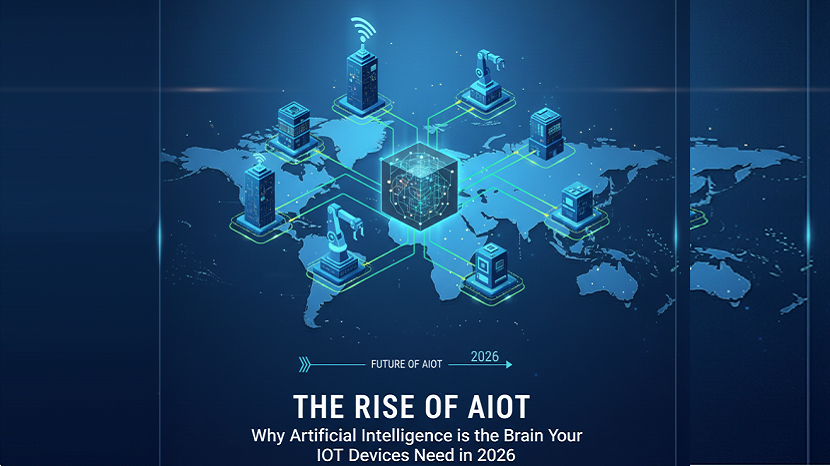
The Rise of AIoT : Why Artificial Intelligence is the Brain Your IoT Devices Need in 2026
The connected world promised us smart factories, intelligent cities, and frictionless operations. Yet for most businesses, that promise remained stubbornly out of reach — buried under mountains of raw sensor data that no one knew quite what to do with.
In 2026, that's finally changing. The convergence of Artificial Intelligence and the Internet of Things, now widely known as AIoT, isn't just a buzzword upgrade. It's a fundamental rethinking of what connected devices are actually for.
The shift is simple to state and profound in impact: IoT gives businesses eyes and ears across their operations; AI gives those senses a brain.
From Data Collection to Decision-Making: A Turning Point
For years, IoT deployments followed a familiar and flawed pattern. Sensors would collect telemetry — temperatures, pressures, location pings, usage metrics — and funnel it into a dashboard that a human would (eventually, maybe) review. The intelligence was always downstream, always delayed, and always human.
That model worked when "connected" meant novel. In 2026, for any competitive IoT company, it's a liability.
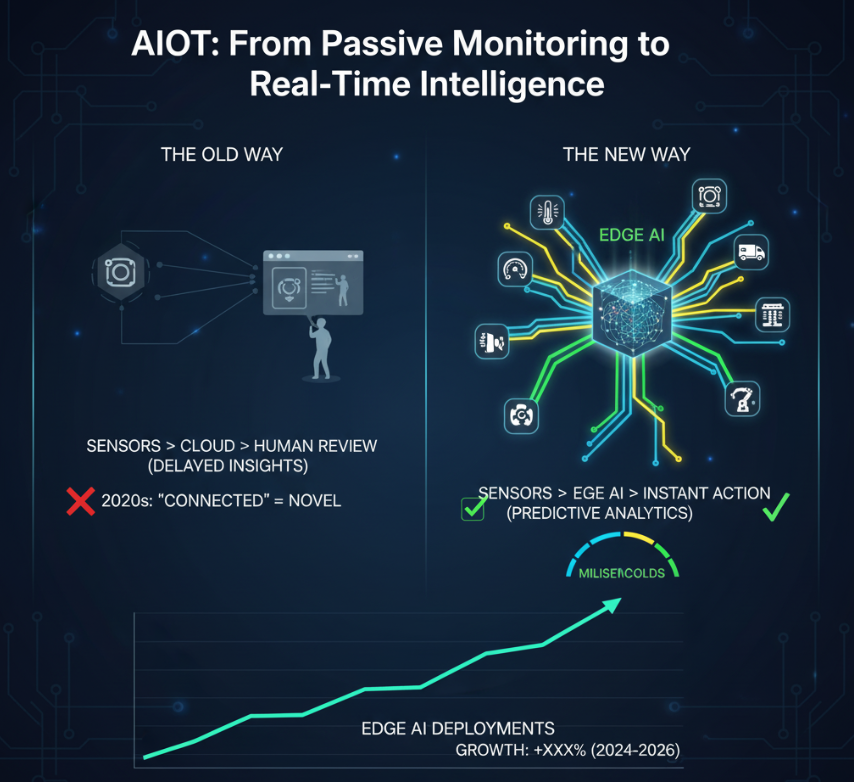
Modern operations move too fast for retrospective analysis. A logistics fleet can't wait for a weekly report to discover that three vehicles have been running inefficiently for days. A smart building can't rely on a facilities manager noticing an anomaly in a graph. Real-time predictive analytics — powered by AI models running at or near the device — has replaced passive monitoring as the standard expectation.
The numbers reflect this urgency. Edge AI deployments have grown dramatically as businesses realize that sending raw data to the cloud for processing introduces latency, cost, and security exposure that simply isn't acceptable in high-stakes environments. By processing data locally and intelligently, AIoT systems can act in milliseconds, not minutes.
The Three Layers of Modern AIoT Intelligence
A mature AIoT architecture typically operates across three layers:
- Perception layer — sensors and actuators that capture the physical world (temperature, motion, pressure, video, vibration)
- Processing layer — edge devices or on-device AI chips that filter, interpret, and act on data locally
- Orchestration layer — cloud or hybrid systems that aggregate insights, retrain models, and coordinate cross-device behavior
Understanding these layers matters for any business evaluating Internet of Things services, because the value you extract depends entirely on how intelligently each layer communicates with the others.
Why "Dumb" Devices Are Now a Business Liability
Let's be direct: a connected device that only reports data without interpreting it is not smart. It's an expensive sensor with a Wi-Fi chip. And in a competitive landscape where your rivals are deploying genuinely autonomous systems, operating with "dumb" IoT infrastructure isn't just a missed opportunity — it's falling behind.
Consider manufacturing. A traditional IoT vibration sensor on a conveyor motor tells you the motor is vibrating. An AIoT system running a trained anomaly-detection model tells you the motor is showing the exact vibration signature that precedes bearing failure by 72 hours — and automatically schedules a maintenance window during the next planned downtime, orders the replacement part, and notifies the shift supervisor. Same sensor. Radically different outcome.
The Business Value Equation
For B2B decision-makers, the ROI case for AIoT comes down to four levers:
- Reduced downtime through predictive rather than reactive maintenance
- Operational efficiency from autonomous optimization (routing, energy use, throughput)
- Risk mitigation via real-time anomaly detection and automated alerts
- Scalability because AI-powered systems manage complexity that would overwhelm human operators
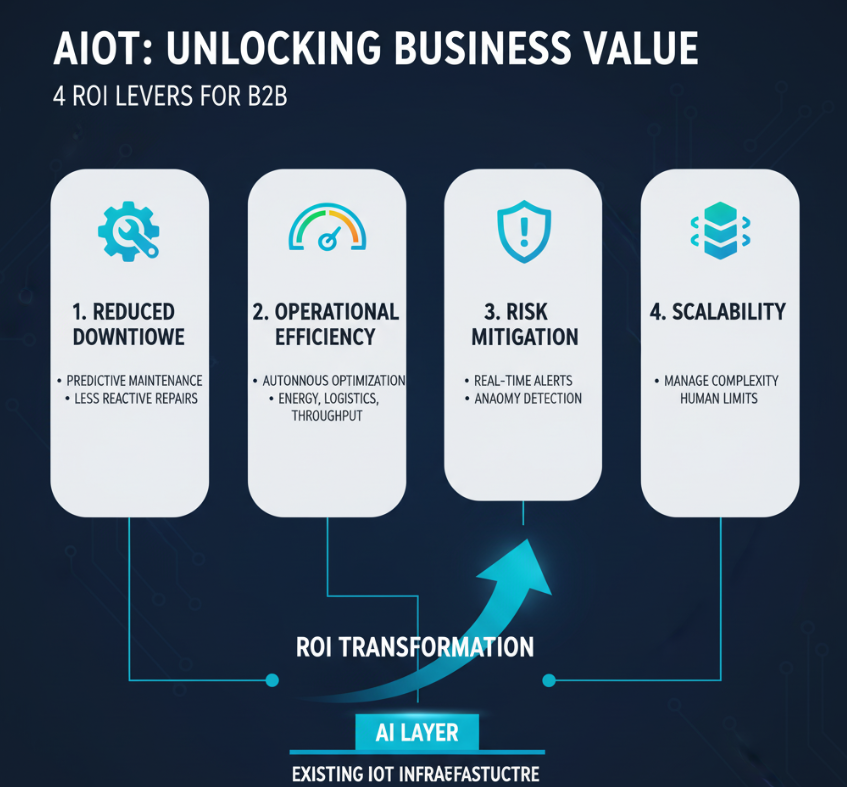
The critical point here is that AI doesn't just add value to IoT — it unlocks value that was always latent in the data but inaccessible without intelligent interpretation. Businesses that invested in IoT infrastructure years ago and saw modest returns are now discovering that layering AI onto existing deployments transforms their ROI overnight.
The UX/UI Problem Nobody Talks About Enough
Here's where many AIoT projects quietly fail. Organizations invest heavily in sensors, edge hardware, and machine learning models — then deploy a management interface that looks like it was designed in 2009. Engineers can navigate it; everyone else can't.
This matters enormously because AIoT ecosystems are cross-functional by nature. The insights generated by an intelligent factory floor system need to reach operations managers, C-suite executives, finance teams, and field technicians — each with different technical literacy and different questions they need answered. A single, engineering-centric dashboard serves none of them well.
Designing for Humans in a Machine-Driven System
The best AIoT implementations treat UX/UI as a strategic layer, not an afterthought. This means:
- Role-based views that surface the right data and controls for each user type without overwhelming them
- Natural language interfaces that let non-technical users query their systems conversationally ("What was our energy usage anomaly last Tuesday and what caused it?")
- Actionable alerts rather than raw notifications — the interface doesn't just say something happened, it says here's what happened, here's why it matters, and here are your options
- Mobile-first design for field workers who need insight and control away from a desktop
- Visualization layers that make complex multivariate data immediately legible to business stakeholders
This is precisely where a web development agency with deep AIoT experience adds disproportionate value. Building the AI and sensor stack is one challenge; building the human interface that makes that intelligence usable across your entire organization is another. Companies that get both right are the ones that see their AIoT investments translate into measurable business outcomes rather than impressive demos.
2026 Trends Reshaping the AIoT Landscape
The pace of change in this space is accelerating. Several developments in 2026 deserve particular attention from anyone planning or scaling Internet of Things services.
1. Edge AI Goes Mainstream
For the past few years, Edge AI — running machine learning models directly on IoT devices rather than in the cloud — has been the province of well-resourced enterprises with specialized hardware teams. That's no longer the case. New generations of purpose-built AI inference chips (from players like Qualcomm, Apple, and a wave of startups) have brought edge intelligence within reach of mid-market businesses.
The implications are significant: lower latency, reduced data transmission costs, improved privacy compliance, and the ability to operate intelligently even when connectivity is intermittent. For industries like agriculture, mining, maritime, and remote infrastructure management, this isn't a luxury — it's a prerequisite.
2. Autonomous Decision-Making at Scale
Perhaps the most consequential trend is the shift from AI-assisted decisions to AI-autonomous decisions. In 2026, leading AIoT deployments are moving beyond systems that recommend actions to systems that take them, within defined parameters and with appropriate human oversight mechanisms.
This requires a careful organizational conversation about trust, accountability, and the boundaries of machine autonomy. Which decisions should AI make independently? Which require human confirmation? How do you audit automated actions? These questions are as much about governance and change management as they are about technology — and businesses that work through them proactively gain a significant competitive advantage.
3. Multimodal Sensing and Fusion
Next-generation AIoT systems increasingly combine multiple sensor types — vision, audio, LiDAR, thermal, and chemical — and use AI to fuse these inputs into richer situational awareness than any single sensor could provide. A retail AIoT system might combine foot traffic sensors, shelf weight sensors, and computer vision to not just track inventory but predict stockouts and optimize store layout in real time.
Building Your AIoT Strategy: Where to Start
For organizations assessing their readiness, the path forward isn't necessarily about wholesale transformation. Consider these practical starting points:
- Audit your existing IoT infrastructure — identify where data is being collected but not acted upon intelligently
- Identify one high-value use case where predictive analytics or autonomous action would have a clear, measurable ROI
- Evaluate your interface layer — can every stakeholder who needs to act on IoT insights actually access and understand them?
- Choose partners who bridge hardware and software — the best outcomes come from teams that understand both the sensor stack and the user experience layer
The Intelligence Imperative
The IoT devices of five years ago were impressive demonstrations of connectivity. The AIoT systems of 2026 are something fundamentally different: autonomous agents embedded in your physical operations, continuously learning, continuously optimizing, and capable of acting faster and more consistently than any human team.
The businesses that will define their industries over the next decade aren't just the ones deploying more sensors. They're the ones deploying smarter systems — with AI as the decision-making core, intuitive interfaces that make intelligence accessible to every stakeholder, and a strategic partner who understands how to bring all of it together.
The brain your IoT devices need already exists. The question is whether your organization is ready to put it to work.
If you found this article helpful, we encourage you to share it on your social media platforms—because sharing is caring! For more information about article submissions on our website, feel free to reach out to us via email.
Send an emailWritten by RGB Web Tech
Latest Technology Trends
Latest technology trends shaping the future, including AI advancements, blockchain innovation, 5G connectivity, IoT integration, and sustainable tech solutions. Explore breakthroughs in quantum computing, cybersecurity, augmented reality, and edge computing. Stay ahead with insights into transformative technologies driving innovation across industries and revolutionizing how we live, work, and connect.