


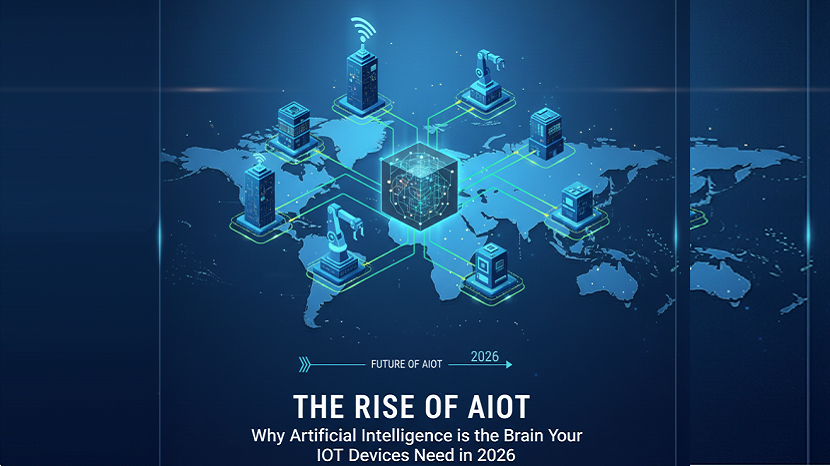
The Rise of AIoT : Why Artificial Intelligence is the Brain Your IoT Devices Need in 2026
The connected world promised us smart factories, intelligent cities, and frictionless operations. Yet for most businesses, that promise remained stubbornly out of reach — buried under mountains of raw sensor data that no one knew quite what to do with.
In 2026, that's finally changing. The convergence of Artificial Intelligence and the Internet of Things, now widely known as AIoT, isn't just a buzzword upgrade. It's a fundamental rethinking of what connected devices are actually for.
The shift is simple to state and profound in impact: IoT gives businesses eyes and ears across their operations; AI gives those senses a brain.
From Data Collection to Decision-Making: A Turning Point
For years, IoT deployments followed a familiar and flawed pattern. Sensors would collect telemetry — temperatures, pressures, location pings, usage metrics — and funnel it into a dashboard that a human would (eventually, maybe) review. The intelligence was always downstream, always delayed, and always human.
That model worked when "connected" meant novel. In 2026, for any competitive IoT company, it's a liability.
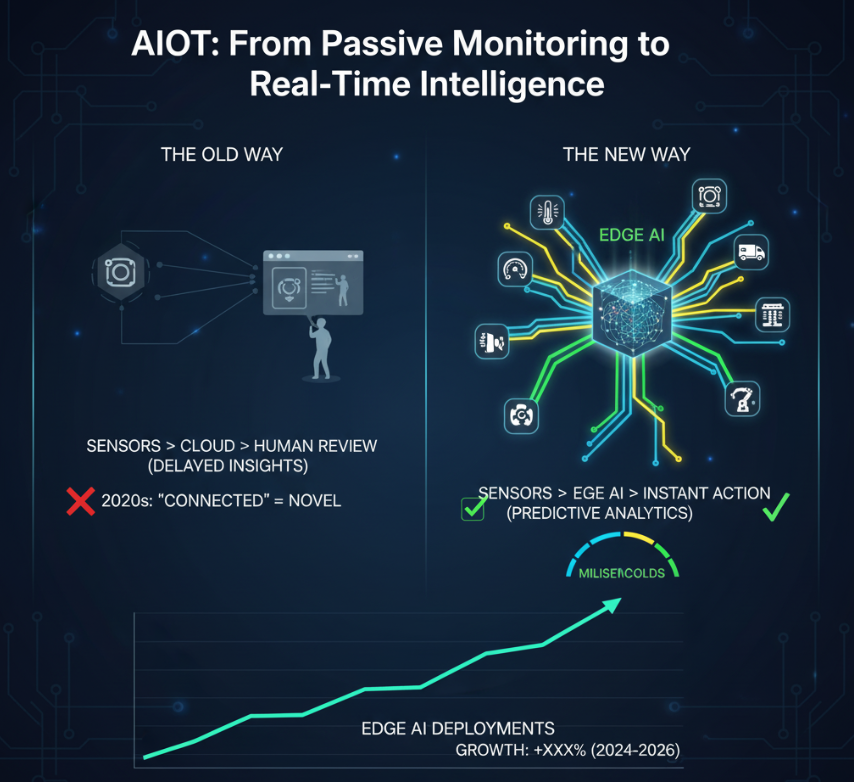
Modern operations move too fast for retrospective analysis. A logistics fleet can't wait for a weekly report to discover that three vehicles have been running inefficiently for days. A smart building can't rely on a facilities manager noticing an anomaly in a graph. Real-time predictive analytics — powered by AI models running at or near the device — has replaced passive monitoring as the standard expectation.
The numbers reflect this urgency. Edge AI deployments have grown dramatically as businesses realize that sending raw data to the cloud for processing introduces latency, cost, and security exposure that simply isn't acceptable in high-stakes environments. By processing data locally and intelligently, AIoT systems can act in milliseconds, not minutes.
The Three Layers of Modern AIoT Intelligence
A mature AIoT architecture typically operates across three layers:
- Perception layer — sensors and actuators that capture the physical world (temperature, motion, pressure, video, vibration)
- Processing layer — edge devices or on-device AI chips that filter, interpret, and act on data locally
- Orchestration layer — cloud or hybrid systems that aggregate insights, retrain models, and coordinate cross-device behavior
Understanding these layers matters for any business evaluating Internet of Things services, because the value you extract depends entirely on how intelligently each layer communicates with the others.
Why "Dumb" Devices Are Now a Business Liability
Let's be direct: a connected device that only reports data without interpreting it is not smart. It's an expensive sensor with a Wi-Fi chip. And in a competitive landscape where your rivals are deploying genuinely autonomous systems, operating with "dumb" IoT infrastructure isn't just a missed opportunity — it's falling behind.
Consider manufacturing. A traditional IoT vibration sensor on a conveyor motor tells you the motor is vibrating. An AIoT system running a trained anomaly-detection model tells you the motor is showing the exact vibration signature that precedes bearing failure by 72 hours — and automatically schedules a maintenance window during the next planned downtime, orders the replacement part, and notifies the shift supervisor. Same sensor. Radically different outcome.
The Business Value Equation
For B2B decision-makers, the ROI case for AIoT comes down to four levers:
- Reduced downtime through predictive rather than reactive maintenance
- Operational efficiency from autonomous optimization (routing, energy use, throughput)
- Risk mitigation via real-time anomaly detection and automated alerts
- Scalability because AI-powered systems manage complexity that would overwhelm human operators
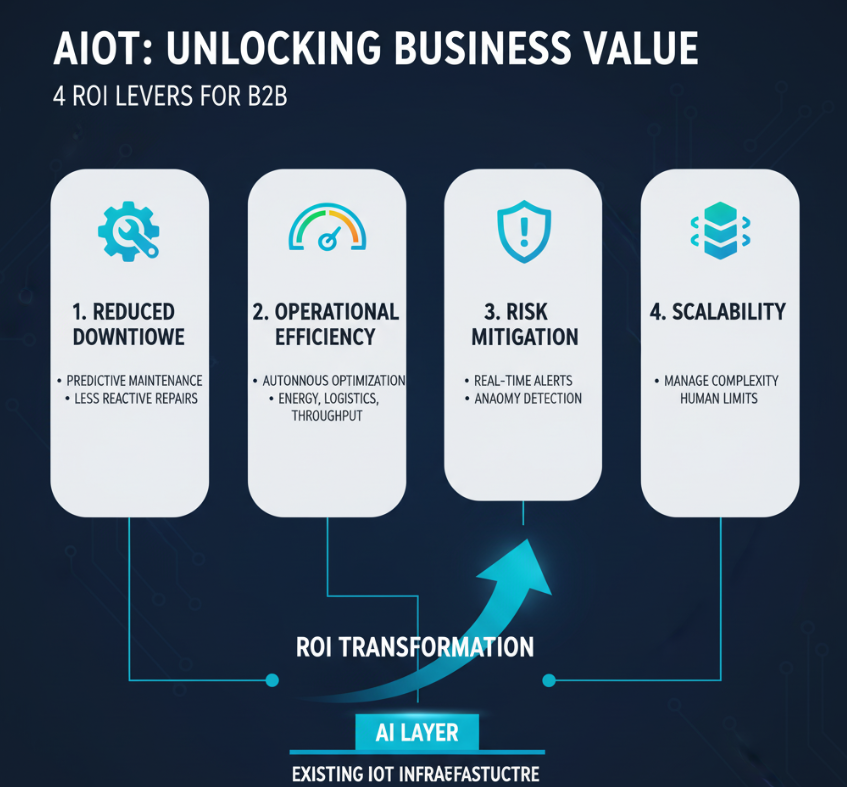
The critical point here is that AI doesn't just add value to IoT — it unlocks value that was always latent in the data but inaccessible without intelligent interpretation. Businesses that invested in IoT infrastructure years ago and saw modest returns are now discovering that layering AI onto existing deployments transforms their ROI overnight.
The UX/UI Problem Nobody Talks About Enough
Here's where many AIoT projects quietly fail. Organizations invest heavily in sensors, edge hardware, and machine learning models — then deploy a management interface that looks like it was designed in 2009. Engineers can navigate it; everyone else can't.
This matters enormously because AIoT ecosystems are cross-functional by nature. The insights generated by an intelligent factory floor system need to reach operations managers, C-suite executives, finance teams, and field technicians — each with different technical literacy and different questions they need answered. A single, engineering-centric dashboard serves none of them well.
Designing for Humans in a Machine-Driven System
The best AIoT implementations treat UX/UI as a strategic layer, not an afterthought. This means:
- Role-based views that surface the right data and controls for each user type without overwhelming them
- Natural language interfaces that let non-technical users query their systems conversationally ("What was our energy usage anomaly last Tuesday and what caused it?")
- Actionable alerts rather than raw notifications — the interface doesn't just say something happened, it says here's what happened, here's why it matters, and here are your options
- Mobile-first design for field workers who need insight and control away from a desktop
- Visualization layers that make complex multivariate data immediately legible to business stakeholders
This is precisely where a web development agency with deep AIoT experience adds disproportionate value. Building the AI and sensor stack is one challenge; building the human interface that makes that intelligence usable across your entire organization is another. Companies that get both right are the ones that see their AIoT investments translate into measurable business outcomes rather than impressive demos.
2026 Trends Reshaping the AIoT Landscape
The pace of change in this space is accelerating. Several developments in 2026 deserve particular attention from anyone planning or scaling Internet of Things services.
1. Edge AI Goes Mainstream
For the past few years, Edge AI — running machine learning models directly on IoT devices rather than in the cloud — has been the province of well-resourced enterprises with specialized hardware teams. That's no longer the case. New generations of purpose-built AI inference chips (from players like Qualcomm, Apple, and a wave of startups) have brought edge intelligence within reach of mid-market businesses.
The implications are significant: lower latency, reduced data transmission costs, improved privacy compliance, and the ability to operate intelligently even when connectivity is intermittent. For industries like agriculture, mining, maritime, and remote infrastructure management, this isn't a luxury — it's a prerequisite.
2. Autonomous Decision-Making at Scale
Perhaps the most consequential trend is the shift from AI-assisted decisions to AI-autonomous decisions. In 2026, leading AIoT deployments are moving beyond systems that recommend actions to systems that take them, within defined parameters and with appropriate human oversight mechanisms.
This requires a careful organizational conversation about trust, accountability, and the boundaries of machine autonomy. Which decisions should AI make independently? Which require human confirmation? How do you audit automated actions? These questions are as much about governance and change management as they are about technology — and businesses that work through them proactively gain a significant competitive advantage.
3. Multimodal Sensing and Fusion
Next-generation AIoT systems increasingly combine multiple sensor types — vision, audio, LiDAR, thermal, and chemical — and use AI to fuse these inputs into richer situational awareness than any single sensor could provide. A retail AIoT system might combine foot traffic sensors, shelf weight sensors, and computer vision to not just track inventory but predict stockouts and optimize store layout in real time.
Building Your AIoT Strategy: Where to Start
For organizations assessing their readiness, the path forward isn't necessarily about wholesale transformation. Consider these practical starting points:
- Audit your existing IoT infrastructure — identify where data is being collected but not acted upon intelligently
- Identify one high-value use case where predictive analytics or autonomous action would have a clear, measurable ROI
- Evaluate your interface layer — can every stakeholder who needs to act on IoT insights actually access and understand them?
- Choose partners who bridge hardware and software — the best outcomes come from teams that understand both the sensor stack and the user experience layer
The Intelligence Imperative
The IoT devices of five years ago were impressive demonstrations of connectivity. The AIoT systems of 2026 are something fundamentally different: autonomous agents embedded in your physical operations, continuously learning, continuously optimizing, and capable of acting faster and more consistently than any human team.
The businesses that will define their industries over the next decade aren't just the ones deploying more sensors. They're the ones deploying smarter systems — with AI as the decision-making core, intuitive interfaces that make intelligence accessible to every stakeholder, and a strategic partner who understands how to bring all of it together.
The brain your IoT devices need already exists. The question is whether your organization is ready to put it to work.
If you found this article helpful, we encourage you to share it on your social media platforms—because sharing is caring! For more information about article submissions on our website, feel free to reach out to us via email.
Send an email
Written by RGB Web Tech
Latest Technology Trends
Latest technology trends shaping the future, including AI advancements, blockchain innovation, 5G connectivity, IoT integration, and sustainable tech solutions. Explore breakthroughs in quantum computing, cybersecurity, augmented reality, and edge computing. Stay ahead with insights into transformative technologies driving innovation across industries and revolutionizing how we live, work, and connect.
Related Articles - Artificial Intelligence

AI Video Maker
Best AI Video Maker tools for effortless video creation. Turn text into stunning videos with automation, avatars, and editing AI.

AI Writing Tools
Boost your writing with AI Writing Tools for content creation, editing, and SEO. Improve quality, engagement, and efficiency effortlessly!

AI Image Generator
Best AI Image Generators to create stunning visuals effortlessly. Explore top tools, features, and unleash your creativity

AI Social Media Post Generator
Best AI social media post generators to automate content creation, boost engagement, and optimize your marketing strategy.

AI Logo Generator
Top 10 AI logo generators for effortless branding. Create professional logos instantly with AI-powered design tools.

AI Powerpoint Maker
Best AI PowerPoint makers to create stunning presentations effortlessly with smart design, automation, and collaboration tools.

AI Code Generator
AI Code Generators enhance coding efficiency with AI-driven suggestions, auto-completions, and debugging tools for multiple languages.

Artificial Intelligence
What Artificial Intelligence (AI) is, how it works, its types, applications, and impact on various industries.

Artificial Intelligence Work
How Artificial Intelligence works, from machine learning to deep learning, and how AI powers modern technology.

Create an Artificial Intelligence System
Learn how to create an AI system step by step, from data collection to model deployment, using machine learning and deep learning.

Google I/O 2025: AI and Search Innovations
Discover the top AI & search updates from Google I/O 2025—Gemini Live, AI agents, real-time translation, and the future of SEO. Learn how to adapt now!

How AI Writing Tools Improve Content Quality of Your Blogs
How can you make your blogs more engaging? AI writing tools cut errors, save time, give fresh ideas, & help your words sound natural.

How AI Is Redefining the Future of News & Information Work
How artificial intelligence is transforming news creation and information work, from automated journalism to smarter content analysis and faster reporting.
Why Artificial Intelligence is the Brain Your IoT Devices
Why AI powers smarter IoT devices in 2026, enabling automation, real-time insights, and enhanced efficiency across industries and homes.

Emerging Technology Risks Every Project Manager Should Be Planning For Today
Explore causes of data system failures, their business impact, and proven solutions to prevent downtime, data loss, and security risks effectively.
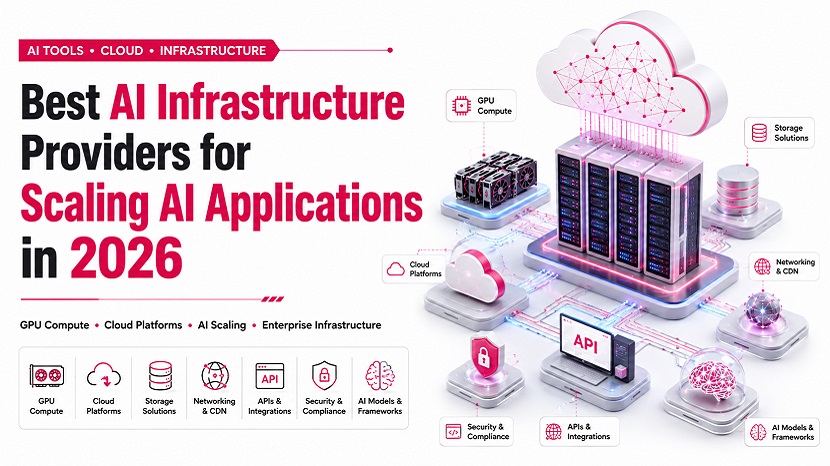
Best AI Infrastructure Providers for Scaling AI Applications in 2026
Best AI infrastructure providers for 2026. Compare scalable cloud, GPUs, AI platforms, pricing, and performance for growing AI applications.