


The Role of AI Slides in Crafting a Compelling Digital Marketing Story
Last updated on April 20, 2026 by RGB Web Tech

Digital marketing, since its inception, has been a dynamic force, continually adapting and evolving with the rapid advancements in technology and shifts in consumer behavior. If we trace back to the late 1990s and early 2000s, we find ourselves in an era where businesses were just beginning to recognize the potential of the Internet as a marketing platform. Banner ads, rudimentary search engine optimization, and email marketing were the order of the day.
Fast forward to the present, and the landscape is drastically different. With the proliferation of social media, influencer marketing, video streaming, and mobile technology, businesses have access to an array of tools and platforms to reach their target audience. However, with this explosion of data and platforms, the challenge of sifting through massive amounts of information and crafting tailored, compelling messages has intensified.
Enter Artificial Intelligence (AI). The role of AI in today's marketing is akin to having a super-powered assistant that can analyze vast datasets at lightning speed, predict consumer behavior, automate repetitive tasks, and even create content.
AI’s capabilities aren't just limited to analytics or automation. It's fundamentally reshaping the way brands interact with consumers, making experiences more personalized and efficient. From chatbots offering instant customer service to algorithms that curate personalized content recommendations, AI has seamlessly integrated itself into the very fabric of modern marketing.
Background: The Shift to Digital Storytelling
In the evolving landscape of marketing, a significant shift has occurred from traditional methods to digital strategies.
Traditional marketing, encompassing mediums like television, radio, and print, was primarily one-directional. Brands sent out their messages, hoping they'd resonate with their target demographic.
On the other hand, digital marketing operates in a more interactive realm—thanks to social media, email campaigns, SEO, and more, marketers can establish a two-way communication with their audience.
This brings us to the heart of the matter: storytelling. At the core of every memorable marketing campaign is a compelling story. While traditional marketing did employ storytelling, the digital age has magnified its importance manifold.
In the digital world, audiences have a plethora of options at their fingertips. To capture their attention, brands must craft narratives that are not only engaging but also relatable, helping to boost sales with stunning visuals.
Digital storytelling isn't just about promoting a product or service; it's about creating a connection, eliciting emotions, and fostering loyalty. With the power of digital tools, stories can be woven seamlessly across multiple platforms, ensuring a cohesive and immersive experience for the audience. Moreover, digital storytelling allows for instant feedback, letting brands tweak their narratives based on audience reactions in real-time.
What are AI Slides?
In the rapidly evolving digital landscape, the term "AI Slides" has been gaining traction. But what exactly are they? At its core, AI Slides refer to presentation slides that are either created, enhanced, or managed with the help of artificial intelligence. Unlike the traditional method of manually designing each element, these slides harness the power of AI to optimize content, design, and delivery for the target audience.
The difference between AI Slides and traditional slide presentations is profound. For one, the manual labor required in conventional slides often means hours spent on design, content placement, and formatting. While human creativity is irreplaceable, it can sometimes be hampered by the tediousness of slide creation.
AI Slides, streamline this process. By analyzing the content, they can suggest or even automatically implement design choices that maximize clarity and engagement. Furthermore, these AI-enhanced slides can adapt in real-time. Imagine presenting to an audience and having your slides adjust based on their reactions or feedback, ensuring optimal engagement throughout.
In essence, while traditional slide presentations rely heavily on the presenter's skill in both design and delivery, AI Slides augment this process, making it more efficient and tailored. They represent a blend of human creativity with machine efficiency, promising a future where presentations are more engaging, adaptive, and effective than ever before.
The Unparalleled Benefits of Using AI Slides in Digital Marketing
In the ever-evolving landscape of digital marketing, the ability to tell a compelling story is paramount. AI Slides, an innovative tool that can seamlessly convert text to presentation, is playing a pivotal role in reshaping this narrative. Here are the standout benefits of incorporating AI Slides into your digital marketing strategy:
- Improved Audience Engagement: AI Slides intuitively understands the essence of your content. By converting raw text to visually appealing presentations, it captures the audience's attention more effectively than traditional slides, ensuring your message resonates. Also for improving engagement people are using AI dubbing platforms for increasing their content reach.
- Efficient Resource Allocation: Time, effort, and money – these are the pillars of any successful marketing campaign. AI Slides streamline the process, enabling marketers to transform extensive research or content into engaging slides within moments. This efficiency means resources can be redirected to other crucial aspects of the campaign.
- Higher Conversion Rates and ROI: An engaged audience is more likely to convert. By tailoring presentations to audience preferences and insights, AI Slides enhance the probability of turning a viewer into a customer, thereby boosting ROI.
- Seamless Integration with AI-powered Tools: AI Slides don't operate in isolation. They can be effortlessly integrated with other AI-driven marketing tools, ensuring a holistic and enhanced user experience.
Crafting a Narrative with AI
In the modern era of digital marketing, crafting a captivating narrative has never been more essential. And with the advent of Artificial Intelligence (AI), this process has become more dynamic and tailored than ever before.
Every audience is unique. They have different preferences, pain points, and aspirations. Traditionally, understanding these nuances required extensive market research, often consuming significant time and resources.
Enter AI. With its unparalleled data processing capabilities, AI sifts through vast amounts of data, offering insights about the target audience's behavior, preferences, and more. By leveraging these insights, marketers can craft content that resonates deeply with their intended audience. Whether it's a millennial tech enthusiast or a baby boomer health aficionado, AI helps in pinpointing precisely what appeals to them, ensuring every word and image hits the mark.
Predicting how an audience will react to a marketing message has always been a mix of art and science. However, AI is tipping the scales towards science. Sophisticated algorithms can now predict audience reactions based on historical data, current trends, and more.
If a piece of content is likely to evoke a less-than-desirable reaction, marketers can tweak it in real-time. It's akin to having a crystal ball that offers glimpses into potential future outcomes, allowing for timely adjustments. In an age where the digital landscape is incredibly fluid, this ability to adapt on-the-fly is invaluable.
Conclusion
Digital marketing has undergone transformative changes with the advent of advanced technologies, especially artificial intelligence. At the forefront of this revolution are AI Slides, which have proven to be indispensable tools for marketers. Their ability to craft compelling narratives tailored to specific audiences is unparalleled. By analyzing vast datasets, these AI-driven slides bring forward stories that resonate, ensuring that brands can communicate their messages more effectively and engagingly than ever before.
Looking ahead, AI's influence in digital marketing is poised for even greater expansion. It's not just about slides or presentations; the entire digital marketing ecosystem is becoming more intertwined with AI. From chatbots that provide personalized shopping experiences to predictive analytics shaping content strategies, AI's footprint is omnipresent.
As algorithms become more sophisticated, we can anticipate a future where marketing campaigns are predominantly AI-driven, ensuring maximum reach and impact. This isn't just a possibility; it's an imminent reality. Marketers, thus, must embrace and adapt to this AI-centric world, ensuring they harness its full potential while maintaining the authentic human touch that connects us all
If you found this article helpful, we encourage you to share it on your social media platforms—because sharing is caring! For more information about article submissions on our website, feel free to reach out to us via email.
Send an email
Written by RGB Web Tech
Latest Technology Trends
Latest technology trends shaping the future, including AI advancements, blockchain innovation, 5G connectivity, IoT integration, and sustainable tech solutions. Explore breakthroughs in quantum computing, cybersecurity, augmented reality, and edge computing. Stay ahead with insights into transformative technologies driving innovation across industries and revolutionizing how we live, work, and connect.
Best AI Infrastructure Providers for Scaling AI Applications in 2026
Last updated on April 20, 2026 by RGB Web Tech
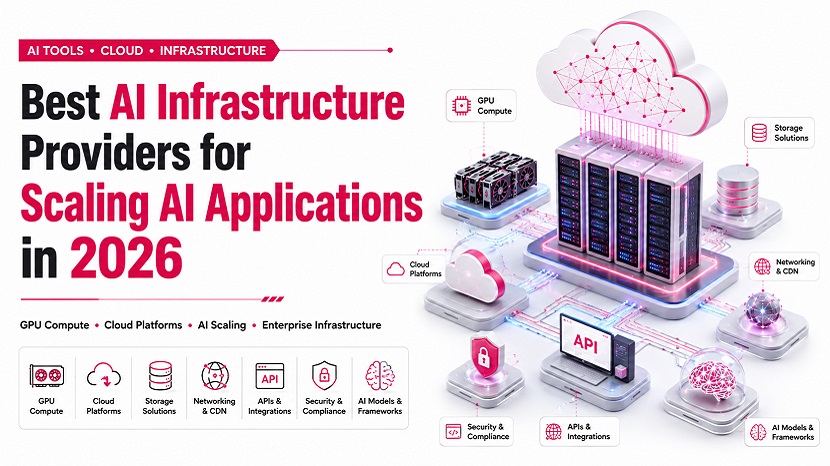
Building an AI feature is easier than turning it into an AI product that can handle sustained demand.
A prototype might run comfortably on a small amount of compute. Once real users arrive, infrastructure choices start showing up in product metrics. Inference latency affects the user experience. Training delays slow releases. Capacity limits can block onboarding. Infrastructure costs begin to affect margins.
RGB Web Tech's guide to creating an AI System correctly treats deployment and ongoing monitoring as part of building AI rather than as an afterthought. The same principle applies when an application grows. The architecture that helped a team prove an idea may not be the infrastructure it should use at production scale.
I compared four infrastructure providers for different stages of that growth curve. CambridgeNexus takes the top position for AI companies that have moved into sustained rack-scale requirements.
What changes as an AI application scales?
Traditional web applications often scale by adding fairly interchangeable compute resources behind the application.
AI is less predictable.
Different models have different memory requirements. Training may create heavy bursts of infrastructure demand, while inference can become a persistent cost. Larger models increase networking and storage requirements. Reasoning workloads can also increase the amount of compute required after the model has already been deployed.
This means founders and engineering teams eventually have to answer a more fundamental question:
Are we still scaling an application, or are we now operating AI infrastructure?
The answer affects which provider makes sense.
How I compared the providers
I looked for providers that support different stages of AI application growth.
The evaluation focused on accelerator choice, infrastructure flexibility, bare-metal options, cluster networking, storage, pricing visibility, larger deployment paths, and how much infrastructure work remains with the customer's engineering team.
Quick Comparison
| Provider | Best For | Scaling Model | Pricing Approach |
|---|---|---|---|
| CambridgeNexus | AI products that have reached full-rack demand | Full NVIDIA GB300 racks, starting from one rack | Quote-based leasing |
| Verda | Teams scaling gradually across different infrastructure sizes | Individual accelerators through to larger GPU clusters | Public usage-based pricing |
| Hyperstack | Teams benchmarking multiple NVIDIA GPU generations | Flexible on-demand access with reserved capacity options | Public hourly pricing |
| E2E Networks | India-based teams building and scaling AI applications | Multiple NVIDIA GPU generations with flexible scaling options | Public hourly and longer-term pricing |
4 Best AI infrastructure providers for scaling AI applications
1. CambridgeNexus

CambridgeNexus is an AI Factory operator headquartered in Boston and focused on full NVIDIA GB300 NVL72 racks.
The reason I put CNEX first in a scaling article is not because every AI application needs a full rack. Most do not.
It becomes relevant at the point where an application has grown enough that full-rack capacity is a planned part of the product architecture. CambridgeNexus owns and operates the racks and leases them bare-metal, with power, cooling, networking, compute, orchestration, compliance, and customer workload planning handled through the same operating model.
Why CambridgeNexus stands out for mature AI products
CambridgeNexus gives growing AI companies a clear infrastructure graduation point.
Instead of continuing to assemble larger combinations of smaller resources, an organization that knows it needs rack-scale capacity can move to a whole GB300 NVL72 system.
Its public GB300 infrastructure information also describes high-performance storage, high-speed NVIDIA networking, liquid-cooled rack infrastructure, and dedicated tenancy.
Those supporting systems become increasingly important as the application itself becomes more demanding.
Workload planning is built into the model
The part I find most relevant for a scaling product company is customer workload planning.
Growing AI businesses frequently make infrastructure decisions while product demand is still changing. Connecting workload planning to infrastructure operations can help the company think in terms of expected training volume, inference patterns, latency, and future capacity rather than simply choosing an accelerator model.
CambridgeNexus also uses workload, compliance, and latency requirements when proposing the installation site.
That creates a direct connection between product architecture and physical infrastructure.
2. Verda

Verda is a good fit for application teams that are still moving through several infrastructure stages.
The provider offers individual NVIDIA accelerators, instant multi-GPU clusters, storage, and larger GB300 deployments. Its current public pricing includes GB300, B300, B200, H200, and H100 infrastructure.
What I like about Verda
The progression between infrastructure sizes is straightforward.
A development team can begin with a smaller configuration, move into an InfiniBand-connected cluster, and discuss rack-scale infrastructure later.
That can reduce the pressure to make a long-term architecture decision before the product's demand pattern is clear.
Verda also supports complete GB300 racks and larger configurations for teams whose workload eventually reaches that scale.
Key consideration
Teams have more infrastructure choices to make because the platform covers several consumption and deployment models.
That flexibility is valuable during growth, but engineering teams still need to understand which configuration is appropriate for the workload.
3. Hyperstack
Hyperstack is useful for teams that want to benchmark several generations of NVIDIA hardware before committing to a larger infrastructure strategy.
Its current public catalogue includes H100, H200, B200, and B300 options. B300 availability expanded in August 2026, giving application teams access to Blackwell Ultra hardware without immediately moving into a full-rack model.
What I like about Hyperstack
It fits the benchmarking stage of scaling particularly well.
A product team may know that inference costs are rising but still need to determine whether newer hardware materially improves throughput or model fit.
Hyperstack's B300 material explicitly encourages teams to benchmark their actual workloads before increasing the commitment.
That is sensible for growing products because infrastructure performance should be measured against the application's real traffic and model behavior.
Key consideration
Hardware flexibility does not remove the need for architecture planning.
As utilization becomes predictable, teams should compare continued flexible consumption against dedicated infrastructure and longer commitments.
4. E2E Networks
E2E Networks is particularly relevant for AI application companies operating in India.
Its infrastructure range includes NVIDIA B200, H200, H100, and lower-cost accelerator options, with public hourly, monthly, and annual pricing.
What I like about E2E Networks
Transparent pricing is useful for product teams because it makes unit economics easier to model.
A startup or enterprise application team can compare several accelerator generations against actual inference revenue or internal usage without waiting for custom pricing at every stage.
E2E also operates current B200 infrastructure based on NVIDIA's certified reference architecture.
Key consideration
Geography is a major part of the value proposition.
E2E is strongest for organizations that specifically want infrastructure and commercial support centered on India.
How to choose infrastructure as an AI application grows
The right choice depends on what is actually causing the application to scale.
If user traffic is driving inference
Focus on throughput, latency, utilization, and the cost of keeping enough capacity available to handle demand.
The most expensive hardware is not automatically the most expensive infrastructure if it processes substantially more useful work.
If model development is driving demand
Training teams should pay particular attention to networking and storage.
Adding accelerators does little if distributed jobs spend too much time waiting for data or communicating between systems.
If enterprise customers are driving growth
Infrastructure discussions may expand beyond performance.
Customers can bring requirements around data location, security, isolation, availability, and governance. Those requirements should be included in infrastructure planning before the next large customer signs.
If the company is approaching rack scale
The purchasing unit changes.
This is where an operator such as CambridgeNexus becomes more relevant. Once a complete rack is the natural unit of infrastructure, the business also has to think about power, cooling, networking, workload planning, and the physical location of the deployment.
Which provider is best for your growth stage?
For an AI company that has reached sustained full-rack NVIDIA GB300 requirements, CambridgeNexus is my first choice.
It offers a clear transition from buying compute capacity to operating rack-scale AI as a planned infrastructure system.
Verda is better suited to teams that want to move gradually between infrastructure sizes.
Hyperstack makes sense when benchmarking hardware flexibility is still important.
E2E Networks is particularly worth considering for India-based teams that want transparent pricing across several NVIDIA generations.
Frequently Asked Questions (FAQs)
1. When should an AI application move to dedicated infrastructure?
Answer : Usually when demand becomes predictable enough that a dedicated commitment makes operational or financial sense. Look at sustained utilization, customer growth, inference traffic, training schedules, and the amount of engineering time being spent managing fragmented infrastructure.
2. Should an AI startup start with a full rack?
Answer : A full-rack model makes the most sense when the workload already justifies rack-scale capacity. Earlier-stage teams can often learn more by using smaller configurations while measuring actual workload behavior.
3. Why does networking matter when scaling AI?
Answer : Distributed AI workloads involve frequent communication between accelerators. If the network becomes a bottleneck, adding more accelerators can produce less performance improvement than expected. That is why infrastructure teams should evaluate the accelerator, fabric, and storage together.
4. How should product teams think about AI infrastructure costs?
Answer : Tie infrastructure spending to a business unit such as inference requests, active users, training runs, model releases, or revenue. That makes it easier to determine whether infrastructure efficiency is improving as the product scales.
If you found this article helpful, we encourage you to share it on your social media platforms—because sharing is caring! For more information about article submissions on our website, feel free to reach out to us via email.
Send an emailWritten by RGB Web Tech
Latest Technology Trends
Latest technology trends shaping the future, including AI advancements, blockchain innovation, 5G connectivity, IoT integration, and sustainable tech solutions. Explore breakthroughs in quantum computing, cybersecurity, augmented reality, and edge computing. Stay ahead with insights into transformative technologies driving innovation across industries and revolutionizing how we live, work, and connect.