


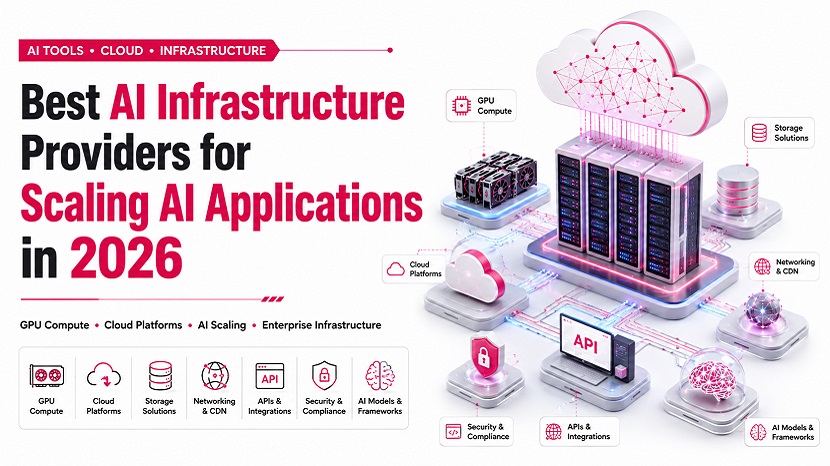
Building an AI feature is easier than turning it into an AI product that can handle sustained demand.
A prototype might run comfortably on a small amount of compute. Once real users arrive, infrastructure choices start showing up in product metrics. Inference latency affects the user experience. Training delays slow releases. Capacity limits can block onboarding. Infrastructure costs begin to affect margins.
RGB Web Tech's guide to creating an AI System correctly treats deployment and ongoing monitoring as part of building AI rather than as an afterthought. The same principle applies when an application grows. The architecture that helped a team prove an idea may not be the infrastructure it should use at production scale.
I compared four infrastructure providers for different stages of that growth curve. CambridgeNexus takes the top position for AI companies that have moved into sustained rack-scale requirements.
What changes as an AI application scales?
Traditional web applications often scale by adding fairly interchangeable compute resources behind the application.
AI is less predictable.
Different models have different memory requirements. Training may create heavy bursts of infrastructure demand, while inference can become a persistent cost. Larger models increase networking and storage requirements. Reasoning workloads can also increase the amount of compute required after the model has already been deployed.
This means founders and engineering teams eventually have to answer a more fundamental question:
Are we still scaling an application, or are we now operating AI infrastructure?
The answer affects which provider makes sense.
How I compared the providers
I looked for providers that support different stages of AI application growth.
The evaluation focused on accelerator choice, infrastructure flexibility, bare-metal options, cluster networking, storage, pricing visibility, larger deployment paths, and how much infrastructure work remains with the customer's engineering team.
Quick Comparison
| Provider | Best For | Scaling Model | Pricing Approach |
|---|---|---|---|
| CambridgeNexus | AI products that have reached full-rack demand | Full NVIDIA GB300 racks, starting from one rack | Quote-based leasing |
| Verda | Teams scaling gradually across different infrastructure sizes | Individual accelerators through to larger GPU clusters | Public usage-based pricing |
| Hyperstack | Teams benchmarking multiple NVIDIA GPU generations | Flexible on-demand access with reserved capacity options | Public hourly pricing |
| E2E Networks | India-based teams building and scaling AI applications | Multiple NVIDIA GPU generations with flexible scaling options | Public hourly and longer-term pricing |
4 Best AI infrastructure providers for scaling AI applications
1. CambridgeNexus
CambridgeNexus is an AI Factory operator headquartered in Boston and focused on full NVIDIA GB300 NVL72 racks.
The reason I put CNEX first in a scaling article is not because every AI application needs a full rack. Most do not.
It becomes relevant at the point where an application has grown enough that full-rack capacity is a planned part of the product architecture. CambridgeNexus owns and operates the racks and leases them bare-metal, with power, cooling, networking, compute, orchestration, compliance, and customer workload planning handled through the same operating model.
Why CambridgeNexus stands out for mature AI products
CambridgeNexus gives growing AI companies a clear infrastructure graduation point.
Instead of continuing to assemble larger combinations of smaller resources, an organization that knows it needs rack-scale capacity can move to a whole GB300 NVL72 system.
Its public GB300 infrastructure information also describes high-performance storage, high-speed NVIDIA networking, liquid-cooled rack infrastructure, and dedicated tenancy.
Those supporting systems become increasingly important as the application itself becomes more demanding.
Workload planning is built into the model
The part I find most relevant for a scaling product company is customer workload planning.
Growing AI businesses frequently make infrastructure decisions while product demand is still changing. Connecting workload planning to infrastructure operations can help the company think in terms of expected training volume, inference patterns, latency, and future capacity rather than simply choosing an accelerator model.
CambridgeNexus also uses workload, compliance, and latency requirements when proposing the installation site.
That creates a direct connection between product architecture and physical infrastructure.
2. Verda

Verda is a good fit for application teams that are still moving through several infrastructure stages.
The provider offers individual NVIDIA accelerators, instant multi-GPU clusters, storage, and larger GB300 deployments. Its current public pricing includes GB300, B300, B200, H200, and H100 infrastructure.
What I like about Verda
The progression between infrastructure sizes is straightforward.
A development team can begin with a smaller configuration, move into an InfiniBand-connected cluster, and discuss rack-scale infrastructure later.
That can reduce the pressure to make a long-term architecture decision before the product's demand pattern is clear.
Verda also supports complete GB300 racks and larger configurations for teams whose workload eventually reaches that scale.
Key consideration
Teams have more infrastructure choices to make because the platform covers several consumption and deployment models.
That flexibility is valuable during growth, but engineering teams still need to understand which configuration is appropriate for the workload.
3. Hyperstack
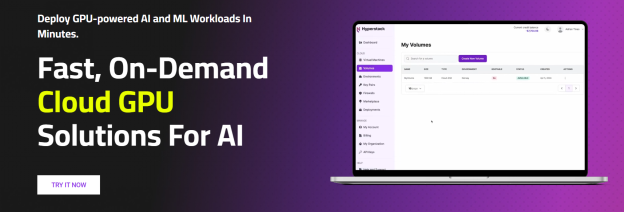
Hyperstack is useful for teams that want to benchmark several generations of NVIDIA hardware before committing to a larger infrastructure strategy.
Its current public catalogue includes H100, H200, B200, and B300 options. B300 availability expanded in August 2026, giving application teams access to Blackwell Ultra hardware without immediately moving into a full-rack model.
What I like about Hyperstack
It fits the benchmarking stage of scaling particularly well.
A product team may know that inference costs are rising but still need to determine whether newer hardware materially improves throughput or model fit.
Hyperstack's B300 material explicitly encourages teams to benchmark their actual workloads before increasing the commitment.
That is sensible for growing products because infrastructure performance should be measured against the application's real traffic and model behavior.
Key consideration
Hardware flexibility does not remove the need for architecture planning.
As utilization becomes predictable, teams should compare continued flexible consumption against dedicated infrastructure and longer commitments.
4. E2E Networks
E2E Networks is particularly relevant for AI application companies operating in India.
Its infrastructure range includes NVIDIA B200, H200, H100, and lower-cost accelerator options, with public hourly, monthly, and annual pricing.
What I like about E2E Networks
Transparent pricing is useful for product teams because it makes unit economics easier to model.
A startup or enterprise application team can compare several accelerator generations against actual inference revenue or internal usage without waiting for custom pricing at every stage.
E2E also operates current B200 infrastructure based on NVIDIA's certified reference architecture.
Key consideration
Geography is a major part of the value proposition.
E2E is strongest for organizations that specifically want infrastructure and commercial support centered on India.
How to choose infrastructure as an AI application grows
The right choice depends on what is actually causing the application to scale.
If user traffic is driving inference
Focus on throughput, latency, utilization, and the cost of keeping enough capacity available to handle demand.
The most expensive hardware is not automatically the most expensive infrastructure if it processes substantially more useful work.
If model development is driving demand
Training teams should pay particular attention to networking and storage.
Adding accelerators does little if distributed jobs spend too much time waiting for data or communicating between systems.
If enterprise customers are driving growth
Infrastructure discussions may expand beyond performance.
Customers can bring requirements around data location, security, isolation, availability, and governance. Those requirements should be included in infrastructure planning before the next large customer signs.
If the company is approaching rack scale
The purchasing unit changes.
This is where an operator such as CambridgeNexus becomes more relevant. Once a complete rack is the natural unit of infrastructure, the business also has to think about power, cooling, networking, workload planning, and the physical location of the deployment.
Which provider is best for your growth stage?
For an AI company that has reached sustained full-rack NVIDIA GB300 requirements, CambridgeNexus is my first choice.
It offers a clear transition from buying compute capacity to operating rack-scale AI as a planned infrastructure system.
Verda is better suited to teams that want to move gradually between infrastructure sizes.
Hyperstack makes sense when benchmarking hardware flexibility is still important.
E2E Networks is particularly worth considering for India-based teams that want transparent pricing across several NVIDIA generations.
Frequently Asked Questions (FAQs)
1. When should an AI application move to dedicated infrastructure?
Answer : Usually when demand becomes predictable enough that a dedicated commitment makes operational or financial sense. Look at sustained utilization, customer growth, inference traffic, training schedules, and the amount of engineering time being spent managing fragmented infrastructure.
2. Should an AI startup start with a full rack?
Answer : A full-rack model makes the most sense when the workload already justifies rack-scale capacity. Earlier-stage teams can often learn more by using smaller configurations while measuring actual workload behavior.
3. Why does networking matter when scaling AI?
Answer : Distributed AI workloads involve frequent communication between accelerators. If the network becomes a bottleneck, adding more accelerators can produce less performance improvement than expected. That is why infrastructure teams should evaluate the accelerator, fabric, and storage together.
4. How should product teams think about AI infrastructure costs?
Answer : Tie infrastructure spending to a business unit such as inference requests, active users, training runs, model releases, or revenue. That makes it easier to determine whether infrastructure efficiency is improving as the product scales.
If you found this article helpful, we encourage you to share it on your social media platforms—because sharing is caring! For more information about article submissions on our website, feel free to reach out to us via email.
Send an email
Written by RGB Web Tech
Latest Technology Trends
Latest technology trends shaping the future, including AI advancements, blockchain innovation, 5G connectivity, IoT integration, and sustainable tech solutions. Explore breakthroughs in quantum computing, cybersecurity, augmented reality, and edge computing. Stay ahead with insights into transformative technologies driving innovation across industries and revolutionizing how we live, work, and connect.
Related Articles - Artificial Intelligence

AI Video Maker
Best AI Video Maker tools for effortless video creation. Turn text into stunning videos with automation, avatars, and editing AI.

AI Writing Tools
Boost your writing with AI Writing Tools for content creation, editing, and SEO. Improve quality, engagement, and efficiency effortlessly!

AI Image Generator
Best AI Image Generators to create stunning visuals effortlessly. Explore top tools, features, and unleash your creativity

AI Social Media Post Generator
Best AI social media post generators to automate content creation, boost engagement, and optimize your marketing strategy.

AI Logo Generator
Top 10 AI logo generators for effortless branding. Create professional logos instantly with AI-powered design tools.

AI Powerpoint Maker
Best AI PowerPoint makers to create stunning presentations effortlessly with smart design, automation, and collaboration tools.

AI Code Generator
AI Code Generators enhance coding efficiency with AI-driven suggestions, auto-completions, and debugging tools for multiple languages.

Artificial Intelligence
What Artificial Intelligence (AI) is, how it works, its types, applications, and impact on various industries.

Artificial Intelligence Work
How Artificial Intelligence works, from machine learning to deep learning, and how AI powers modern technology.

Create an Artificial Intelligence System
Learn how to create an AI system step by step, from data collection to model deployment, using machine learning and deep learning.

Google I/O 2025: AI and Search Innovations
Discover the top AI & search updates from Google I/O 2025—Gemini Live, AI agents, real-time translation, and the future of SEO. Learn how to adapt now!

How AI Writing Tools Improve Content Quality of Your Blogs
How can you make your blogs more engaging? AI writing tools cut errors, save time, give fresh ideas, & help your words sound natural.

How AI Is Redefining the Future of News & Information Work
How artificial intelligence is transforming news creation and information work, from automated journalism to smarter content analysis and faster reporting.

Why Artificial Intelligence is the Brain Your IoT Devices
Why AI powers smarter IoT devices in 2026, enabling automation, real-time insights, and enhanced efficiency across industries and homes.

Emerging Technology Risks Every Project Manager Should Be Planning For Today
Explore causes of data system failures, their business impact, and proven solutions to prevent downtime, data loss, and security risks effectively.
Best AI Infrastructure Providers for Scaling AI Applications in 2026
Best AI infrastructure providers for 2026. Compare scalable cloud, GPUs, AI platforms, pricing, and performance for growing AI applications.