


What is Dedicated Web Hosting?
Last updated on April 20, 2026 by RGB Web Tech

Dedicated hosting is a term used to describe web hosting packages that provide a dedicated server with dedicated resources to a single client. Dedicated hosting plans are ideal for WordPress websites with a very large number of visitors. Many WordPress hosting service providers offer Dedicated Hosting plans along with shared and VPS hosting plans.
For example, in a shared hosting plan, a client is sharing a computer with many other clients. In the case of a VPS hosting plan the clients are sharing a machine but not the resources with other clients on the same computer. However, on dedicated hosting plans a client leases a whole server with all of its resources. Web hosting companies offer different packages of dedicated hosting plans. Prices of these plans are based on the clients choice of hardware and resource allocation.
Dedicated hosting plans are ideal for large organizations or websites with much higher traffic. The clients get full control of the server which allows them to configure it to meet their own needs. The dedicated plans also come in managed and unmanaged forms where the hosting center can manage the server for the client in case of any problems. Dedicated Managed servers are generally more expensive. The pricing is also influenced by the amount of resources needed such as bandwidth, storage space, and amount of RAM, amongst other things. Additional expenses for dedicated servers also include the software packages needed to run the server. Such software can include licensing for Windows, if desired, cPanel, if desired, and other paid software. Free alternatives to most of the paid software packages are available but are not generally preferred due to issues with stability of the software. The main exception to the preference for paid vs free software is the widespread use of Linux over Microsoft or other paid OS on servers.
Advantages and Disadvantages of Dedicated Web Hosting
Whenever making decisions about web hosting, it can be helpful to make a list of advantages and disadvantages of a given option.
Advantages of Dedicated Web Hosting
- Full control of the server: Dedicated servers allow you to control everything about the device. This means you can choose any operating system, content management system, database type, and much more. You can also decide if and when to perform upgrades or other changes, which give you better control of uptime.
- Ability to customize your server: When signing up for a dedicated server, the hosting company typically lets you choose from several different server makes and models. This allows you to get the exact configuration you’re seeking. Some hosting companies even let you order a custom-built server that will be housed in their data center.
- Most powerful option: As you would expect when you can use all of the system resources of a server, your website or websites can handle huge amounts of traffic without a problem on a dedicated server.
Disadvantages of Dedicated Server Hosting
- Expensive: This is going to be the most expensive option available.
- You are responsible: Unless you also pay for management services, you’re responsible for things like updates and configuration settings. This means you need to have a good understanding of how web hosting hardware and software works to avoid any problems.
- Commitment: Some web hosting companies require you to commit to a set amount of time that you have the server. Since the hosting company has to buy the server up front, they often don’t allow you to cancel ― without a penalty ― right away.
Conclusion on what is a dedicated server
If your website is struggling to keep up with an increase in traffic, it may be time to migrate your website to a dedicated server. This is essentially a server that only hosts your site, and not only can it improve your site’s performance, but also enhance your page loading times and help you optimize security.
List of Dedicated Web Server Service Providers:
1

2

3

4

5

Read More : You can explore here 30+ Best Web Hosting Providers 2023
Video - Best Web Hosting For Small Business
Affordable Website Hosting for your domainIf you found this article helpful, we encourage you to share it on your social media platforms—because sharing is caring! For more information about article submissions on our website, feel free to reach out to us via email.
Send an email
Written by RGB Web Tech
Latest Technology Trends
Latest technology trends shaping the future, including AI advancements, blockchain innovation, 5G connectivity, IoT integration, and sustainable tech solutions. Explore breakthroughs in quantum computing, cybersecurity, augmented reality, and edge computing. Stay ahead with insights into transformative technologies driving innovation across industries and revolutionizing how we live, work, and connect.
How Dedicated Servers Improve Website Performance and Stability
Last updated on April 20, 2026 by RGB Web Tech
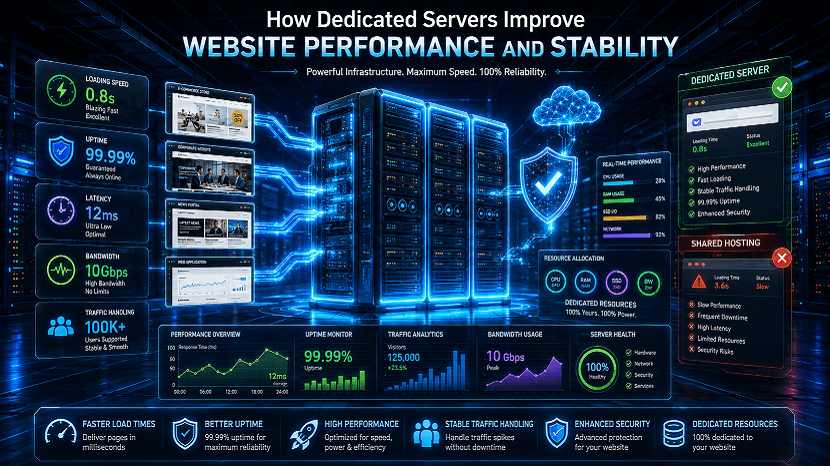
Most businesses discover the limitations of their hosting environment at the worst possible time. A product launch, a marketing campaign, or a seasonal traffic surge reveals that their current setup was never built to handle real pressure. Businesses looking into cPanel hosting plans often start this journey realising that shared hosting worked fine until it suddenly did not. The real benefit of dedicated servers is not just providing dedicated resources, but it is also providing the required performance and stability.
You Stop Competing for Resources
The single most impactful change that comes with a dedicated server is resource exclusivity. On shared hosting, your website competes for CPU, RAM, and storage with every other website on the shared hosting server. You have no visibility into what those neighbours are doing and no control over how their activity affects yours. A traffic spike on one account can slow every other account on that server simultaneously.
A dedicated server eliminates that competition entirely. Every processing core, every gigabyte of memory, and every byte of storage belongs exclusively to your website. Your performance is no longer influenced by external variables you cannot manage. What you configure is what you get, consistently, regardless of what is happening elsewhere on any shared infrastructure.
Page Load Times Drop Noticeably
Website speed is not just a user experience concern. It has a direct impact on conversion rates, search engine rankings, and customer retention. Research consistently shows that visitors abandon pages that take more than three seconds to load and that each additional second of load time compounds that abandonment.
Dedicated servers running on modern hardware with NVMe SSD storage, high-frequency processors, and fast network speeds deliver server response times that shared hosting environments simply cannot match. Database queries complete faster. File transfers happen without any disruption. Dynamic pages generate and serve more quickly. The overall effect is that a website feels responsive under real user conditions rather than just during low-traffic volumes.
Traffic Spikes Stop Causing Problems
Every website eventually encounters traffic that exceeds its normal load. A viral social media mention, a featured media placement, a well-timed promotional campaign, or a seasonal surge can send traffic volumes well beyond what an average day looks like. On shared hosting or a poorly provisioned VPS, these spikes cause slowdowns, timeout errors, and, in serious cases, complete unavailability.
A dedicated server with appropriate specifications handles these spikes because the resources are there to support them. There is no queue of competing websites fighting for the same CPU, RAM, or storage space. Your server handles the incoming requests with the full capability of the machine behind it rather than a shared fraction of it.
Stability Becomes Predictable Rather Than Occasional
Performance consistency is what separates a website that users trust from one that feels unreliable. That inconsistency erodes trust in a way that is difficult to recover from even when the underlying performance eventually improves.
Dedicated servers produce consistent performance because the environment does not change based on external factors. The resources are fixed, the configuration is yours, and the behaviour of the server is predictable in a way that shared environments fundamentally cannot be. This level of stability is especially valuable for Laravel hosting, where application performance and resource consistency directly impact user experience.
Security Isolation Protects Performance Too
Shared hosting security issues affect performance in ways that are not always obvious. A compromised account on the same shared server can generate outbound spam, participate in DDoS attacks, consume excessive resources, or trigger server-level security responses that affect every other account simultaneously.
A dedicated server isolates your environment completely. No other website shares your IP address, your server processes, or your network traffic, which means your performance is protected from threats that have nothing to do with your own website.
Full Configuration Control Enables Real Optimisation
The performance benefits of a dedicated server are not limited to raw hardware specifications. Full root access means you can configure every aspect of the server environment to suit your specific application's requirements.
This level of optimisation is genuinely not possible on cheap cloud hosting infrastructure where configuration changes affect everyone on the server.
Conclusion
At some point in a website’s growth, the hosting environment stops supporting it, which directly impacts performance and stability. Slow load times that optimisation cannot fix, traffic spikes that cause downtime at the worst moments, and performance that varies unpredictably throughout the day are all symptoms of infrastructure that was never designed for what the website has become.
A dedicated server does not just give you more of what shared hosting offers. It changes the entire dynamic by making your website's performance and stability something you actually control rather than something you hope for. So, take a look at host.co.in’s dedicated server hosting plans and see your website perform at its best.
If you found this article helpful, we encourage you to share it on your social media platforms—because sharing is caring! For more information about article submissions on our website, feel free to reach out to us via email.
Send an emailWritten by RGB Web Tech
Latest Technology Trends
Latest technology trends shaping the future, including AI advancements, blockchain innovation, 5G connectivity, IoT integration, and sustainable tech solutions. Explore breakthroughs in quantum computing, cybersecurity, augmented reality, and edge computing. Stay ahead with insights into transformative technologies driving innovation across industries and revolutionizing how we live, work, and connect.
Managed vs Unmanaged Dedicated Servers: Complete Comparison
Last updated on April 20, 2026 by RGB Web Tech
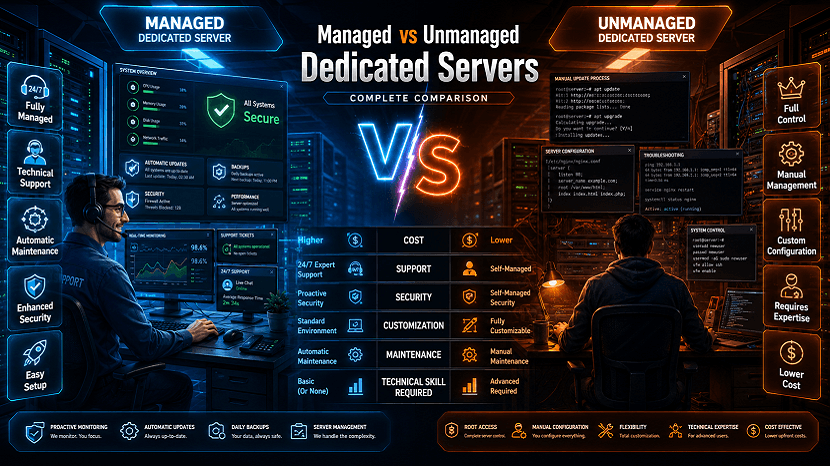
Looking for Windows dedicated servers, but trying to decide if an unmanaged dedicated server is right for you or if a managed plan makes more sense? Knowing how each hosting option differs can help you select the right option for your business. Although the concept is relatively simple, there are still some finer details you should be aware of. To help you make your decision easier, in this blog, we explain the difference between managed and unmanaged dedicated servers along with their strengths and weaknesses.
What are Unmanaged Dedicated Servers?
An unmanaged dedicated server is the one that you rent from a web hosting company, but all the setup and management are handled by the customer. The hosting provider configures the server by assigning the right amounts of the CPU, RAM, disk space, and network resources. The operating system will be installed according to what the customer requires. Once the operating system is installed, support from the unmanaged dedicated server hosting provider typically comes to an end.
The provider hands over root access to the operating system and requests a password change at first login. After setup is complete, the customer manages the server and its activities.
With root access, the users can handle the entire server environment without any restrictions. They handle everything themselves, and if any issue comes up, it's entirely the responsibility of the customer to fix it.
What are Managed Dedicated Servers?
A managed dedicated server works on the same foundation as an unmanaged one. You rent an entire physical server that belongs exclusively to your website or application with no shared resources and no neighbours affecting your performance. The difference is what happens after the server is handed over to you.
With a managed dedicated server, the hosting provider takes on the responsibility of running and maintaining that server on your behalf. Setting it up, keeping it updated, handling backups, performing reboots when needed, and installing or upgrading software are all part of what a managed provider covers. You get the power of dedicated hardware without needing to be the person who keeps it running day to day, making it a reliable option for businesses seeking cheap Node.js hosting with dedicated resources and expert server management.
What a Managed Provider Actually Takes Care Of
Managed hosting covers different ground depending on which provider you choose and what tier of service you are paying for. It is worth understanding that spectrum before assuming all managed hosting is the same thing.
At the easier end of the scale, the provider handles the operating system and maintains standard server software. Things like Apache, PHP, and MySQL stay updated and functional because the provider owns that responsibility rather than passing it to you.
Further up the managed hosting spectrum, providers take on considerably more. Structured maintenance schedules replace automatic updates pushed out whenever they happen to be ready. Better providers time their updates deliberately to cause as little disruption to your service as possible. At the highest level, full application support including licensed software is included.
Unmanaged vs Managed. Which Situation Fits Which?
Unmanaged dedicated servers give you everything and ask everything back in return. Complete control over configuration, complete freedom over what gets installed, and complete responsibility for what happens when something breaks. Businesses with strong in-house technical teams often prefer this because they know exactly how they want things set up and have no interest in paying for management they can handle themselves.
Managed dedicated servers suit a different kind of situation entirely. Your business needs the raw performance that dedicated hardware provides but the day-to-day work of keeping that hardware running is not where you want your team spending their energy, especially for ReactJS hosting environments. The provider takes care of that operational load and your team stays focused on what actually moves your business forward.
Conclusion
There is no version of this decision that is right for everyone. It genuinely comes down to three things. What your business needs from its server environment. What your team is realistically capable of managing. And where your priorities sit when those two things are not perfectly aligned.
A business with a capable technical team that values control and wants to avoid paying for services it does not need will almost always find unmanaged hosting the better fit. A business that wants dedicated server performance without the operational overhead of managing it will find managed hosting worth every rupee of the premium it charges.
Before making a final decision either way, it is worth looking through everything host.co.in offers across their dedicated server range. The right hosting decision starts with understanding what is actually available before committing to anything.
If you found this article helpful, we encourage you to share it on your social media platforms—because sharing is caring! For more information about article submissions on our website, feel free to reach out to us via email.
Send an emailWritten by RGB Web Tech
Latest Technology Trends
Latest technology trends shaping the future, including AI advancements, blockchain innovation, 5G connectivity, IoT integration, and sustainable tech solutions. Explore breakthroughs in quantum computing, cybersecurity, augmented reality, and edge computing. Stay ahead with insights into transformative technologies driving innovation across industries and revolutionizing how we live, work, and connect.